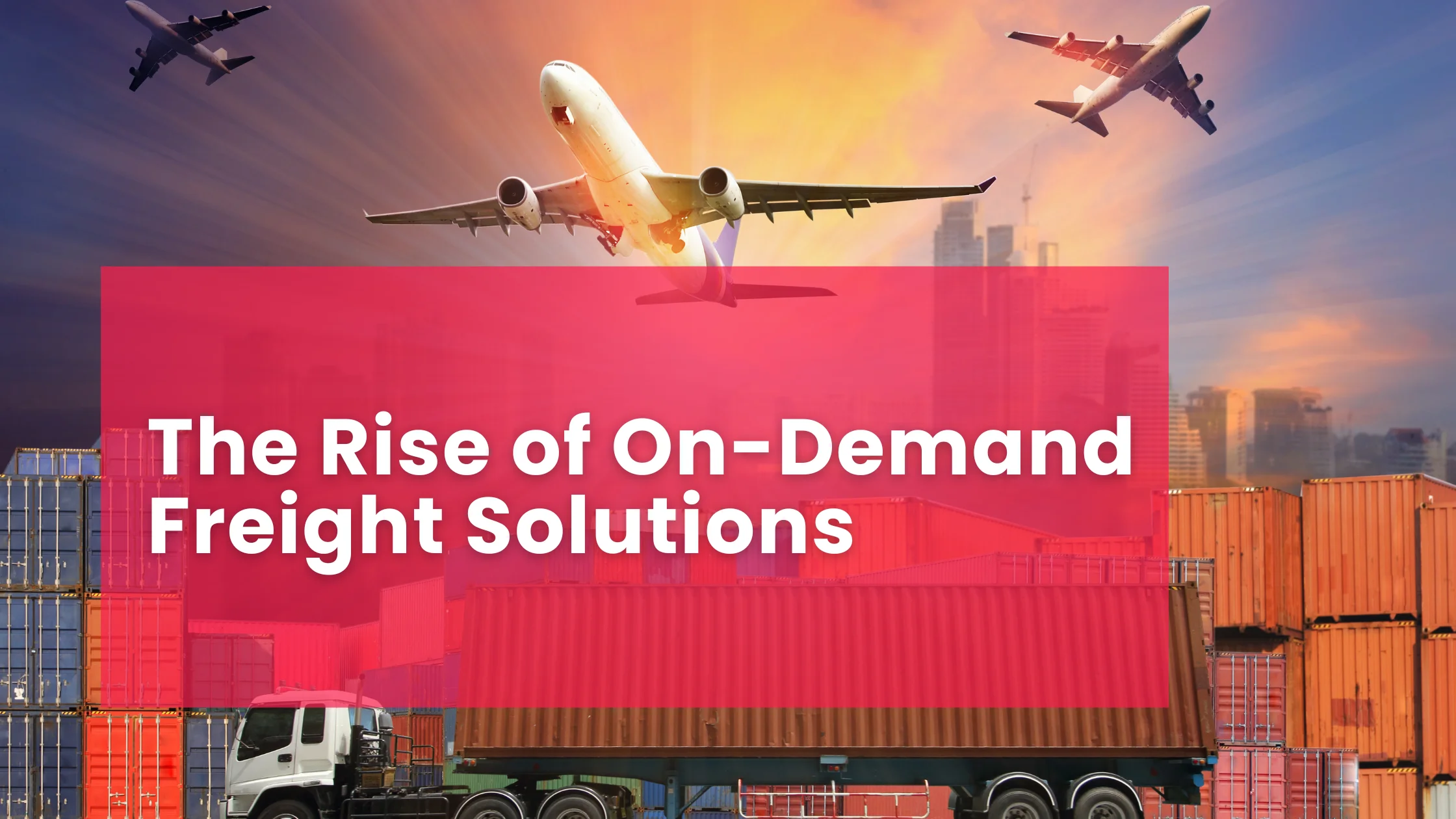
Global trade no longer moves at one speed. Businesses today operate in a market shaped by shorter product lifecycles, unpredictable demand patterns, tighter customer expectations, and constant pressure to reduce landed costs without sacrificing service. In this environment, traditional freight models built around fixed schedules and rigid planning cycles are no longer enough on their own. Companies increasingly need logistics solutions that can adapt in real time. This is where on-demand freight is changing the conversation.
The rise of on-demand freight solutions reflects a broader shift in supply chain strategy. Instead of treating transportation as a static function, businesses now view freight as a flexible, responsive capability that must support growth, resilience, and customer satisfaction. Whether the need is urgent international air freight, time-sensitive ocean coordination, last-minute customs support, multimodal routing, or expedited delivery across borders, on-demand freight offers the agility modern supply chains require.
For importers, exporters, procurement teams, and supply chain leaders, this model is not simply about speed. It is about control, visibility, smarter decision-making, and the ability to respond to commercial realities without losing momentum. For global logistics providers, it demands deeper expertise, stronger carrier networks, better operational coordination, and the ability to solve problems under pressure.
AGOL Worldwide Inc supports businesses navigating this evolving logistics landscape with tailored international freight forwarding, customs brokerage, supply chain solutions, and global trade services designed to match real-world urgency with reliable execution.
What On-Demand Freight Really Means
On-demand freight refers to transportation and logistics solutions that are arranged, adjusted, or accelerated based on immediate business needs rather than fixed long-term schedules alone. It allows companies to respond quickly when requirements change, shipments become urgent, inventory gaps appear, or market conditions shift unexpectedly.
This can include a wide range of logistics scenarios. A manufacturer may need emergency air freight to prevent a production shutdown. A retailer may require rapid replenishment ahead of a demand spike. A healthcare supplier may need a sensitive shipment routed with tighter controls and faster transit. A project cargo client may need a specialized solution arranged around an evolving installation timeline. In each case, the freight strategy must be built around the moment, not just the standard operating model.
On-demand freight does not replace conventional shipping programs. Instead, it strengthens them. It creates a responsive layer within a broader supply chain framework, giving businesses the flexibility to act when normal planning assumptions no longer hold. The best on-demand freight solutions integrate seamlessly with long-term logistics strategies, balancing urgency, compliance, cost, and delivery performance.
Why On-Demand Freight Solutions Are Growing
The increase in on-demand freight demand is tied directly to how business has changed. Companies today work in a more volatile and interconnected trading environment. A delay in one country can disrupt production in another. A port issue can affect retail promotions in multiple markets. A sudden change in demand can leave businesses short on stock, materials, or components with little warning.
Several factors are driving this growth.
Faster Customer Expectations
Customers across industries expect shorter lead times and more reliable delivery windows. In business-to-business markets, delayed freight can halt operations, postpone launches, or weaken service commitments. In business-to-consumer environments, delivery speed and consistency often influence brand loyalty. Companies that cannot move goods quickly when conditions change risk losing business.
Greater Supply Chain Volatility
Global supply chains remain exposed to disruptions from port congestion, weather events, labor shortages, geopolitical developments, regulatory shifts, and carrier capacity fluctuations. When planned routes or timelines fail, businesses need immediate alternatives. On-demand freight provides a mechanism for maintaining continuity.
Leaner Inventory Strategies
Many organizations have reduced buffer inventory to improve cash flow and warehouse efficiency. While this can strengthen financial performance, it also leaves less room for transportation delays. On-demand freight becomes essential when replenishment must happen quickly to avoid stockouts, missed production, or lost sales.
Global Sourcing Complexity
Sourcing across multiple countries can improve cost competitiveness, but it also introduces more moving parts into the logistics process. Different carrier options, customs requirements, transit times, handover points, and documentation standards can increase risk. Businesses need logistics partners that can rapidly coordinate freight across borders without compromising control.
Demand for Real-Time Decision-Making
Modern supply chains increasingly depend on timely information. Companies want visibility into where goods are, what options exist, and how transportation decisions affect total supply chain performance. On-demand freight fits this environment because it is rooted in flexibility, responsiveness, and informed execution.
The Business Value of On-Demand Freight
On-demand freight is often associated with urgent transport, but its strategic value goes much deeper. When handled properly, it helps businesses protect revenue, reduce operational risk, and build more resilient supply chains.
Business Continuity
A delayed shipment can create a chain reaction across procurement, manufacturing, distribution, and customer service. On-demand freight reduces the impact of disruptions by enabling companies to act quickly. Instead of waiting for standard freight cycles to catch up, businesses can secure alternative capacity, faster modes, or revised routing to keep operations moving.
Stronger Customer Commitments
Reliable fulfillment matters. When businesses can respond quickly to unexpected freight needs, they are better positioned to meet customer deadlines, support contractual obligations, and maintain service quality even under pressure. This reinforces trust and strengthens long-term relationships.
Better Inventory Management
On-demand freight gives supply chain leaders another lever to manage inventory more precisely. Rather than overstocking as a hedge against delays, companies can use responsive freight solutions to support more balanced inventory planning. This does not eliminate the need for safety stock, but it can reduce dependence on high inventory levels as the only protection against uncertainty.
Reduced Cost of Disruption
Expedited freight may carry a higher direct transportation cost than standard options, but the cost of inaction is often far greater. Production downtime, missed tenders, delayed launches, contractual penalties, spoiled goods, or damaged customer relationships can quickly exceed the premium paid for fast, flexible logistics. The right decision is not always the cheapest freight option. It is the option that best protects business value.
Greater Agility in Competitive Markets
Companies that can adapt quickly to shifting conditions are better able to capitalize on new opportunities. Whether entering a new market, responding to seasonal demand, supporting a time-sensitive project, or managing an urgent supplier issue, on-demand freight helps businesses move with speed and confidence.
Core Features of Effective On-Demand Freight Solutions
Not all freight providers are equipped to deliver true on-demand support. Speed alone is not enough. Effective on-demand freight depends on a combination of operational strength, global reach, and logistics expertise.
Rapid Response Capability
Urgent freight decisions often need to happen within hours, not days. A capable logistics partner must assess the shipment requirements quickly, identify routing options, confirm carrier availability, and coordinate execution without delay. This requires strong internal processes and real operational experience.
Multimodal Flexibility
The best solution is not always limited to one transport mode. Depending on the shipment profile, destination, budget, and urgency, an on-demand strategy may involve air freight, ocean freight, trucking, rail, or a multimodal combination. A partner with access to multiple modes can design solutions that match both commercial and operational priorities.
Customs and Compliance Expertise
International freight cannot move efficiently without proper customs planning and documentation. Urgent shipments still need to meet regulatory requirements. In many cases, the customs process can determine whether a shipment moves smoothly or stalls at the border. This makes customs brokerage and trade compliance a critical part of any on-demand freight solution.
Global Network Strength
Responsive freight requires reliable access to carriers, agents, terminals, and operational support across regions. A strong international logistics network allows providers to secure capacity, coordinate handoffs, and manage exceptions more effectively.
Shipment Visibility
Visibility is essential when freight is moving under tight deadlines. Businesses need timely updates, clear communication, and confidence that the shipment is being managed proactively. Good visibility supports better internal planning and faster issue resolution.
Tailored Execution
Every urgent shipment has different priorities. Some require the fastest possible transit. Others need balanced cost control, specialized handling, temperature management, oversized cargo coordination, or route adjustments around local constraints. Effective on-demand freight is never purely generic. It is customized to the situation.
Industries Benefiting from On-Demand Freight
On-demand freight serves a wide range of sectors because time-sensitive logistics challenges exist across nearly every industry. However, some sectors rely on it more heavily because the consequences of delay are particularly high.
Manufacturing businesses use on-demand freight to prevent line stoppages, support just-in-time production, and manage supplier disruptions. Retail and ecommerce companies depend on it to replenish inventory quickly, respond to seasonal demand shifts, and protect customer delivery commitments. Technology businesses may need urgent movement of components, finished equipment, or infrastructure assets. Healthcare and life sciences often require tightly controlled freight for critical goods where delays can have serious operational consequences. Energy, telecom, and industrial project sectors use on-demand solutions when equipment, parts, or project cargo must reach sites on strict timelines.
In each of these industries, the underlying need is the same. Freight is not just a transport function. It is a business enabler.
On-Demand Freight and the Role of Technology
Technology has played a major role in the rise of on-demand freight, but technology alone is not the solution. Digital tools make it easier to compare options, monitor shipments, exchange documents, and support communication across the supply chain. They improve speed and decision-making. Yet freight execution still depends heavily on human expertise, especially in international logistics where exceptions are common.
The most effective on-demand freight models combine both. Technology provides visibility, data, and process efficiency. Experienced logistics teams provide judgment, coordination, compliance support, and real-time problem solving.
For businesses, this matters because urgent freight situations are rarely simple. A shipment may require rerouting due to congestion, customs intervention because of documentation inconsistencies, repacking for airline acceptance, coordination across multiple time zones, or last-minute changes at origin or destination. These situations demand more than a digital booking platform. They require a logistics partner that understands how global freight actually moves.
The Difference Between Speed and Strategic Urgency
One of the biggest misconceptions about on-demand freight is that it is always about moving everything as fast as possible. In reality, the strongest logistics decisions are not driven by panic. They are driven by priorities.
Strategic urgency means identifying what truly matters in a specific shipment scenario. Is the main goal to recover lost time? Avoid production downtime? Meet a delivery commitment? Control premium freight costs? Comply with destination regulations? Protect sensitive cargo? Support a high-value customer account? The answer changes the freight strategy.
Sometimes the best response is expedited air freight. Sometimes it is a split shipment, where critical units move first and the balance follows on a more economical mode. Sometimes it is rerouting through a different gateway. Sometimes it is a customs-first planning approach to avoid border delays. Businesses gain the most value when on-demand freight is treated as a precise solution, not a blanket reaction.
Common Challenges in On-Demand Freight Management
While on-demand freight offers clear advantages, it also brings challenges that require experienced handling.
Capacity constraints can limit options during peak periods or on high-demand trade lanes. Documentation errors can create major delays, especially when a shipment is already moving under pressure. Poor coordination between suppliers, carriers, brokers, and consignees can result in missed cutoffs or handover problems. Cost control can become difficult if urgent freight decisions are made without sufficient planning or shipment prioritization. Limited visibility can create internal confusion and weaken stakeholder communication.
These challenges are exactly why businesses benefit from working with a logistics partner that can coordinate freight holistically. A provider with freight forwarding, customs brokerage, and supply chain expertise can help reduce friction across the process, not just book transport.
Best Practices for Businesses Using On-Demand Freight
Companies do not need to wait for a crisis to improve how they use on-demand freight. A more proactive approach can strengthen both speed and efficiency.
First, businesses should define escalation criteria. Not every delay justifies premium freight. Clear internal guidelines help teams decide when urgent transport is necessary and when alternative responses are more appropriate.
Second, shipment data should inform decision-making. Reviewing the causes of urgent freight requests can reveal recurring issues such as supplier delays, inaccurate forecasting, documentation problems, or weak inventory alignment. Solving root causes reduces future disruption.
Third, logistics planning should connect procurement, operations, and customer commitments. On-demand freight becomes more effective when the broader business understands the cost, value, and purpose of rapid transport decisions.
Fourth, companies should work with logistics partners that offer integrated services. Freight forwarding, customs brokerage, trade compliance, and supply chain coordination must work together, especially when time is limited.
Finally, communication matters. The faster an issue is identified and escalated, the more options remain available. Businesses that share timely shipment information with their logistics providers are better positioned to secure effective solutions.
Why Partnering with the Right Logistics Provider Matters
The growth of on-demand freight has increased expectations for logistics providers. Businesses no longer need a vendor that simply moves cargo from point A to point B. They need a partner that can think ahead, act fast, and manage complexity across the shipment lifecycle.
A trusted logistics partner should bring more than transport access. They should offer route planning insight, customs knowledge, carrier coordination, documentation support, exception management, and the ability to align freight decisions with wider business goals. They should understand that every urgent shipment carries commercial consequences.
This is where experience becomes especially important. In global logistics, pressure exposes weaknesses. When capacity is tight, deadlines shift, or customs complications arise, expertise makes the difference between recovery and delay.
AGOL Worldwide Inc supports clients with global logistics solutions built around reliability, responsiveness, and operational control. With capabilities across international freight forwarding, customs brokerage, supply chain solutions, and global trade services, AGOL helps businesses manage both planned logistics programs and time-sensitive freight requirements with confidence.
The Future of On-Demand Freight Solutions
On-demand freight is not a temporary trend. It is becoming a permanent feature of modern supply chain strategy. As global trade grows more interconnected and customer expectations continue to rise, businesses will need transportation models that offer greater adaptability.
Several developments are likely to shape the future of this space. Companies will continue investing in real-time visibility and predictive logistics tools. Data-driven planning will help businesses identify risks earlier and trigger faster responses. Multimodal strategies will become more common as organizations seek greater resilience across trade lanes. Compliance and customs planning will remain central as regulations evolve and border scrutiny increases. Most importantly, businesses will continue prioritizing partners that can combine digital capability with proven logistics execution.
The companies that succeed will be those that treat freight as a strategic function rather than a back-end necessity. They will understand that responsive logistics is not only about solving emergencies. It is about enabling growth, protecting service levels, and building supply chains that can perform under changing conditions.
Final Thoughts
The rise of on-demand freight solutions reflects a clear market reality. Businesses need logistics that can move as quickly as commerce itself. In a world of tighter deadlines, unpredictable disruption, and growing global complexity, flexible freight is no longer optional for many organizations. It is an essential part of staying competitive.
For importers, exporters, procurement leaders, and supply chain professionals, the value of on-demand freight lies in its ability to protect continuity, strengthen customer commitments, and create room for smarter decision-making when conditions change. But success depends on more than fast transport. It depends on choosing a logistics partner with the experience, infrastructure, and global trade knowledge to execute under pressure.
AGOL Worldwide Inc helps businesses navigate urgent and complex logistics demands with customized international freight forwarding, customs brokerage, supply chain solutions, and global trade services tailored to real operational needs. To explore a more responsive approach to global shipping and connect with a team that understands the realities of international trade, connect with AGOL Worldwide Inc for customized global logistics solutions.